




If you've noticed your sleep shifting as you've gotten older, like waking earlier, lying awake longer, feeling less rested despite a full night, you're not imagining it. Sleep genuinely changes with age, and the reasons are biological, not behavioural. It's not that you're doing something wrong. It's that your body is doing something different.
Understanding what's actually happening and what can help are the most important steps to doing something useful about it.
The architecture of sleep shifts
Sleep isn't a single state. It moves through cycles - light sleep, deep sleep, and REM sleep - repeating several times across the night. Each stage serves a different function. Deep sleep, also called slow-wave sleep, is where the most physically restorative work happens: tissue repair, immune function, memory consolidation, and the clearance of metabolic waste from the brain. REM sleep is where emotional processing and cognitive restoration take place.
As we age, the proportion of time spent in deep sleep decreases. The sleep cycles don't disappear, but they become shallower. Less time in the stages that do the heaviest lifting means you can technically be asleep for eight hours and still wake up feeling like you didn't rest.
This isn't a personal failing. It's a documented shift in sleep architecture that begins gradually in midlife and becomes more pronounced after 50.
-
Melatonin production declines
Melatonin is the hormone that signals to the body that it's time to sleep. It's produced by the pineal gland in response to darkness, and it plays a central role in regulating the sleep-wake cycle.
Production of melatonin decreases with age, and the decline can be significant. The result is that the internal signal to wind down becomes weaker and less reliable. Sleep onset takes longer. The body doesn't shift into sleep mode as efficiently as it once did. And because melatonin also influences the timing of the sleep cycle, its decline contributes to the tendency to wake earlier in the morning, often long before you'd choose to.
-
The circadian rhythm shifts forward
The circadian rhythm (the internal 24-hour clock that governs sleep, wakefulness, body temperature, hormone release, and dozens of other biological processes) tends to shift forward with age. This is sometimes called a phase advance.
In practical terms, it means the body starts signalling sleepiness earlier in the evening and waking readiness earlier in the morning. For many people over 50, this shows up as struggling to stay awake past 9 or 10pm, then waking at 4 or 5am regardless of when they went to bed.
This shift isn't a disorder, it's a normal age-related change. But it can create friction with the demands of daily life, especially when social schedules, work, or family commitments don't align with an earlier internal clock.
-
Hormonal changes play a significant role
For women, the hormonal shifts of perimenopause and menopause have a direct and often dramatic impact on sleep. Declining oestrogen and progesterone affect thermoregulation, which is why night sweats and hot flushes are such a common and disruptive feature of this stage. Progesterone in particular has sleep-promoting properties, so its decline can contribute to difficulty falling and staying asleep independent of any temperature disruption.
The result for many women in their late 40s and 50s is a period where sleep quality deteriorates sharply, not because of stress or lifestyle, but because the hormonal scaffolding that supported good sleep has changed significantly.
For men, declining testosterone across midlife also affects sleep quality and is associated with increased rates of sleep-disordered breathing. The hormonal picture is different, but the impact on sleep is real in both cases.
-
Stress and cortisol become harder to manage at night
The relationship between cortisol, the primary stress hormone, and sleep is reciprocal. Poor sleep elevates cortisol, and elevated cortisol disrupts sleep. As we age, the regulation of this feedback loop becomes less precise.
Cortisol is supposed to follow a clear daily pattern: high in the morning to support wakefulness and alertness, declining through the day, and low at night to allow sleep. With age, and particularly under chronic stress, this pattern can flatten or become dysregulated. Evening cortisol that stays higher than it should makes it harder to wind down, harder to fall asleep, and contributes to the light, fragmented sleep that many people over 50 describe.
This is where stress management stops being a soft recommendation and becomes genuinely relevant to sleep quality. The nervous system's ability to shift from an activated state into one conducive to sleep becomes something that requires more active support with age.
What actually helps
The lifestyle fundamentals, like consistent sleep and wake times, a cool dark room, limiting alcohol and caffeine in the evening, managing screen exposure before bed, remain relevant and worth taking seriously. They work with the biology rather than against it.
Beyond the basics, targeted nutritional support can make a meaningful difference.
Magnesium plays a well-established role in nervous system regulation and muscle relaxation, both of which are relevant to sleep onset and quality. L-theanine, an amino acid found naturally in tea, promotes relaxation without sedation, it takes the edge off an activated nervous system without leaving you groggy. Reishi mushroom has a long history of use for sleep and stress support, and emerging research supports its role in promoting deeper, more restorative sleep.
None of these are sedatives. They work by supporting the conditions the body needs to wind down and sleep well, which is exactly what becomes harder to achieve naturally after 50.
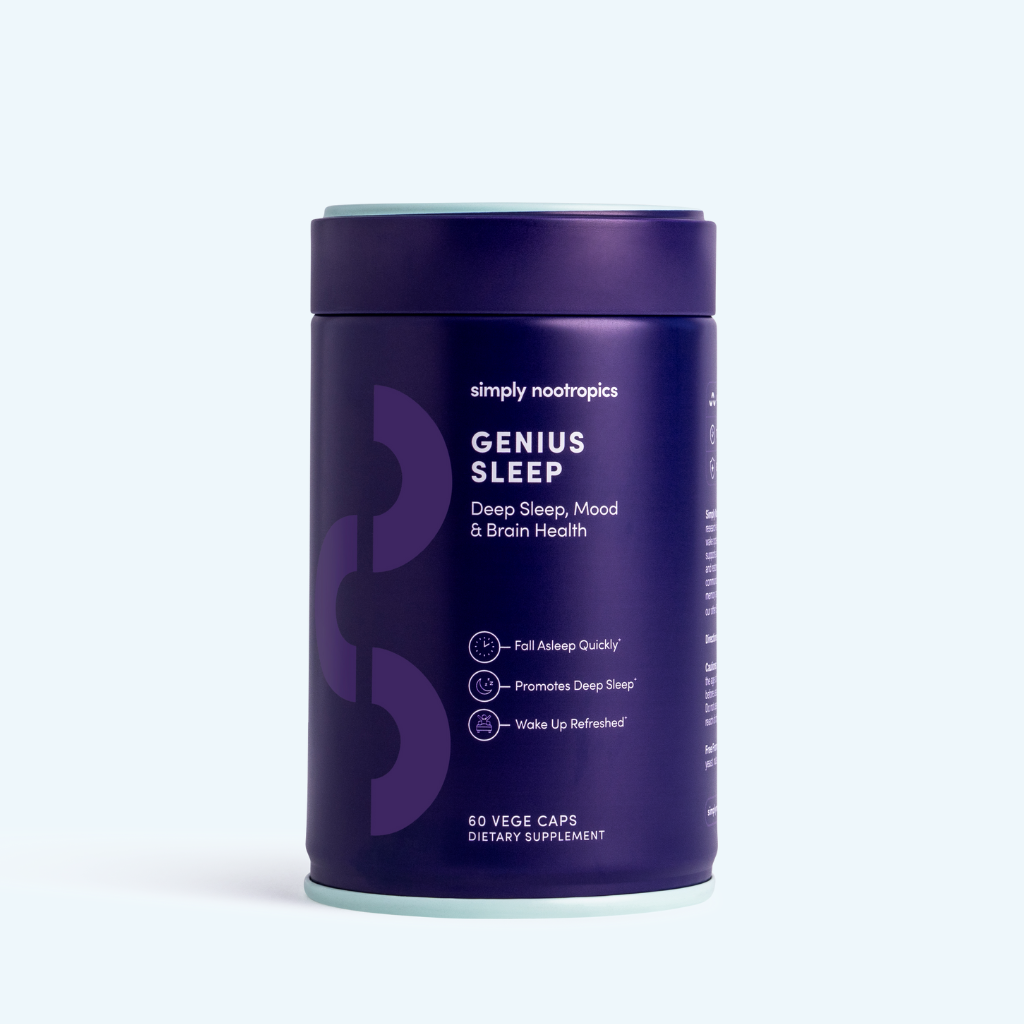
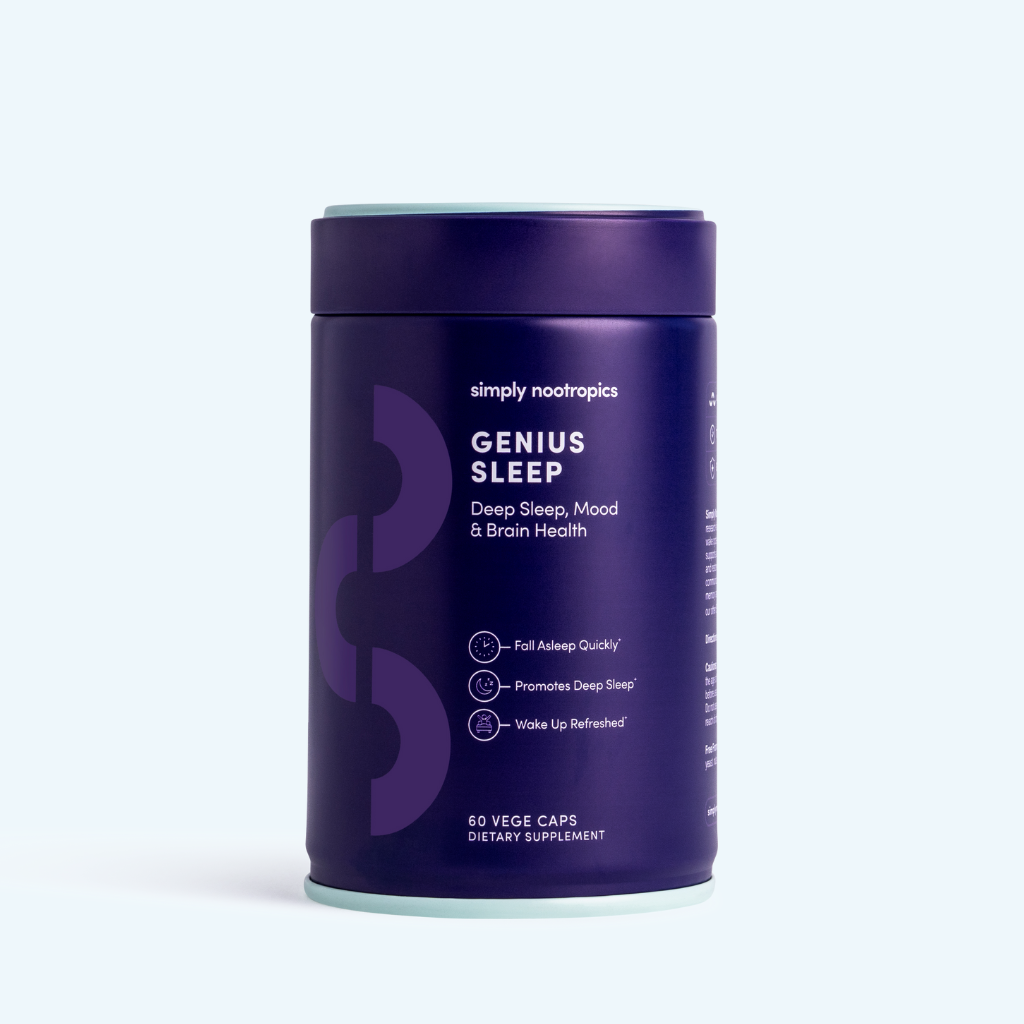
Genius Sleep
Genius Sleep is formulated specifically for the kind of sleep support that becomes more relevant with age. Each capsule contains Reishi mushroom, L-theanine, Magnesium Bisglycinate, and more, all ingredients chosen for their complementary roles in wind-down, relaxation, and sleep depth.
No melatonin. No sedatives. Just the nutritional support your body needs to do what it's supposed to do - sleep properly.